Schematic Line Art
Abstract, circle-based compositions drawn in a single hairline, with small rounded-square nodes marking the moments that matter.
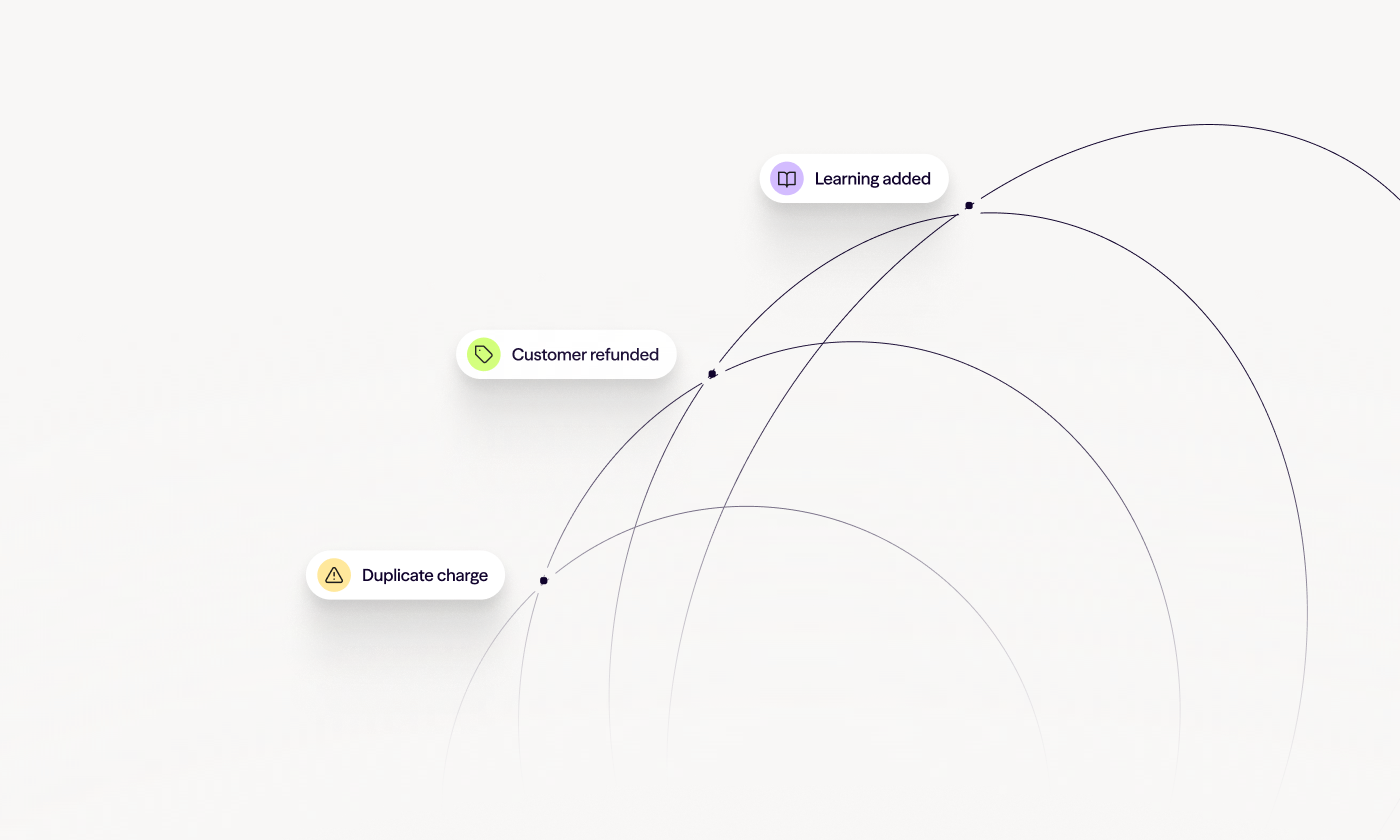
Anatomy
| Element | Spec |
|---|---|
| Line | 1px Deep Blue #10022C, no fill. Hold it at 1px at any size (vector-effect: non-scaling-stroke). Never black, gradient, dashed, or shaded. |
| Node | A small square with slightly rounded corners: 6–8px (up to about 10px on large canvases), with a corner radius of 25–33% of its size. Fill nodes Deep Blue. One node at most can be Purple #7C52FF, marking the hub or the resolved point. |
| Node ring | A 2.5–3.5px outer stroke in the ground color, so the line breaks around the node. It reads as white on a white container, Light Tan on Light Tan, and Tan on Tan. |
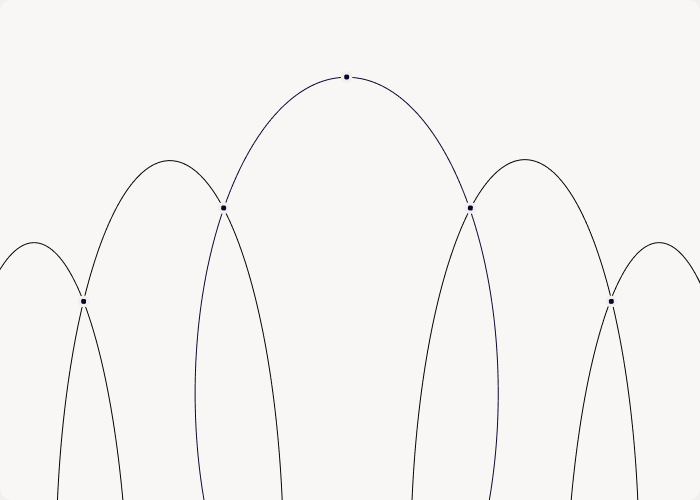
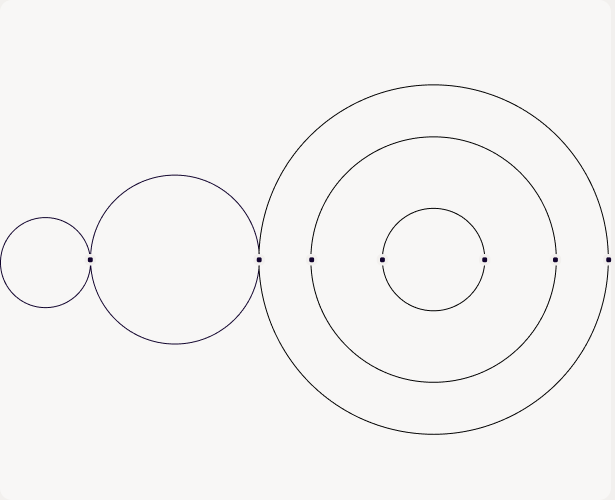
| Geometry | Circles, ellipses, arcs, concentric and tangent rings, overlapping petals, a single spiral, or arches rising from an edge. Let the panel edge crop large forms. |
| Panel | Tan with a 20px radius, or Light Tan inside a white box with a 16px radius. |
| Overlays | Optional white stage or status pills centered over their nodes, with an 8px radius and the pill shadow. Keep overlays few and let the line art carry the idea. |
Composition
- One idea per graphic, drawn as one gesture. Balance it as a mirror or order it as a wave, with generous negative space.
- Make the forms mean something:
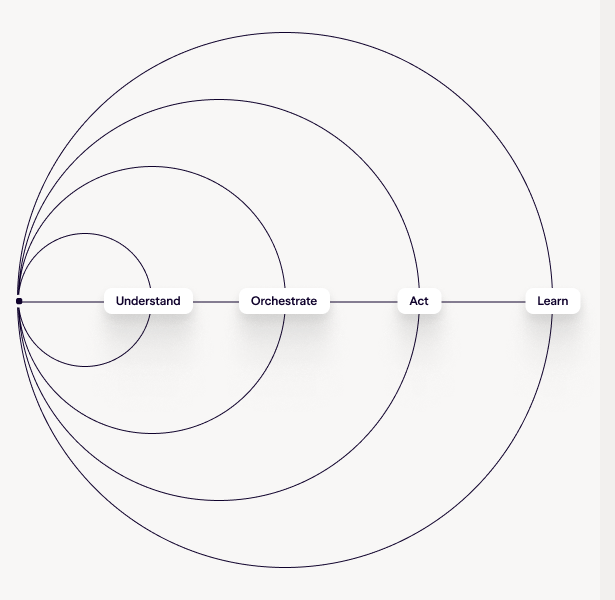
- Tangent circles for a loop or stages.
- Overlapping circles for shared context.
- A bridging circle for connection.
- Concentric rings for depth.
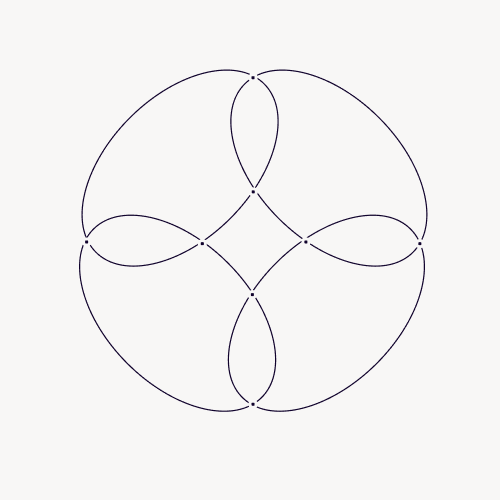
- Petals from a hub for orchestration.
- It's not a network graphic. No random node meshes, straight-line node-to-node webs, or floating specks. Place nodes only where something happens: intersections, tangent points, axis crossings, and the ends of an arc.
- Never add icons inside nodes, arrows, shading, color fills, or gradients.
Motion
Line art moves calmly and precisely, with no overshoot.
- Draw-on: trim each stroke from its start, 1.0s per stroke (1.3–1.6s for large rings) on
cubic-bezier(0.33, 1, 0.68, 1). - Stagger: strokes within one figure start 0.2–0.5s apart and overlap. Order them as one gesture, such as center-out or left-to-right.
- Node pop: each node scales from 0 to 1 over 0.4–0.5s, the moment its stroke reaches it.
- Pills: fade in and rise 24px over 0.4s on
cubic-bezier(0.35, 0, 0.1, 1)when their arc is half drawn. - In-page graphics play once when about 35% visible. Don't loop or replay them on scroll. Hero graphics, like the Resolve loop, can loop.
- Reduced motion: always honor
prefers-reduced-motionby showing the finished, static graphic.
On a dark surface
Use this only when a dark background is explicitly requested. Draw lines and nodes in Light Tan, ring each node in the dark ground color, and use at most one Ultra Light Purple #D3BCFF accent node.
Schematic Line Art documentation last updated Tuesday, October 20, 2026